

Postcard From Rome
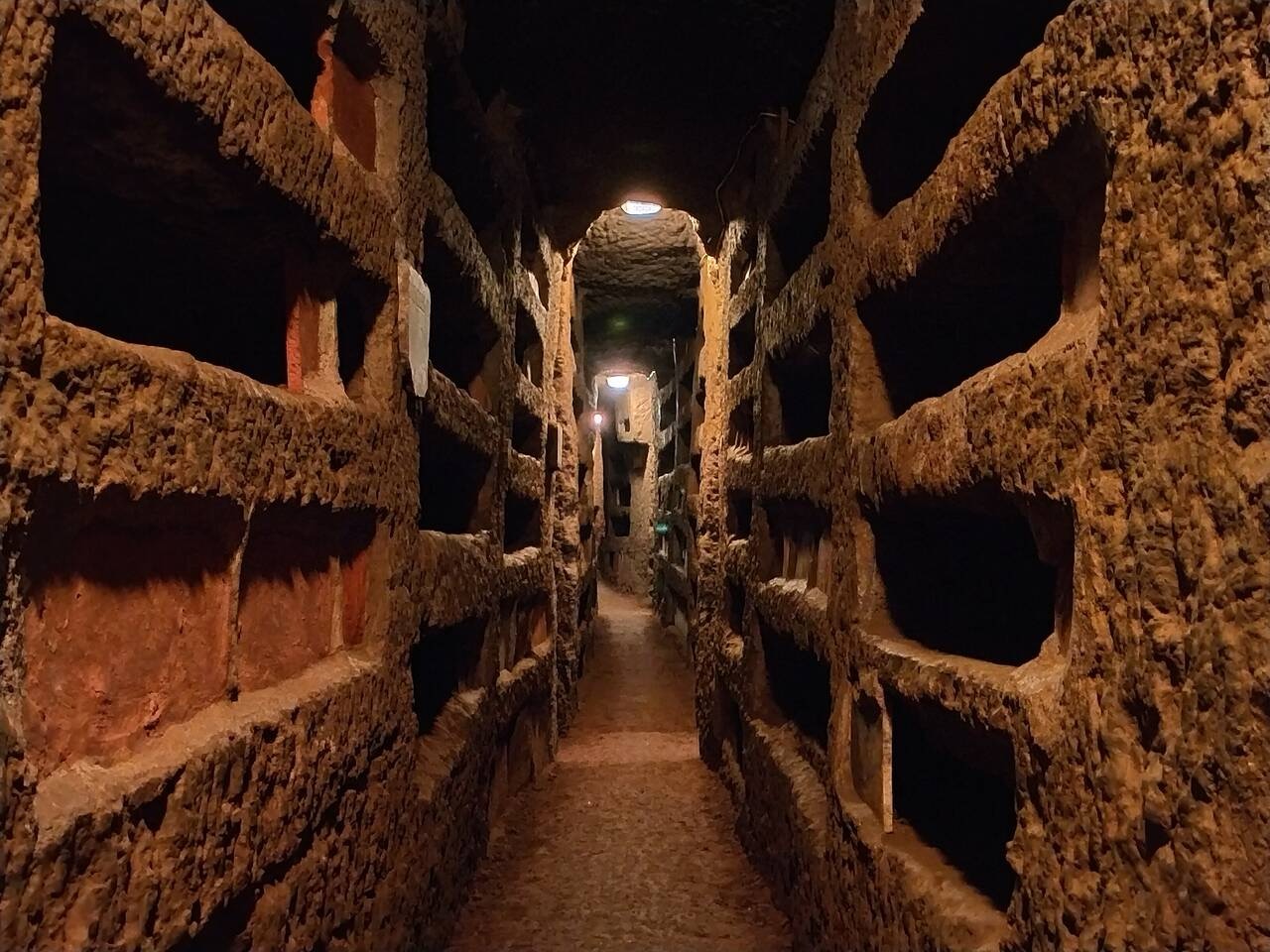
This week I am on pilgrimage in Rome, the “eternal city,” where our band of pilgrims visited the catacombs of St. Callixtus, located on an elevated hill outside the city walls. It was here, in the first centuries of the Church, that Christians built the catacombs to provide resting places for those who had died. Legend has it that the catacombs were also places where Christians could gather and worship in safety.
There was certainly persecution of Christians, beginning with Nero in AD 64 and continuing until the fourth century. For refusing to offer sacrifices and prayers to the Romans gods or to the emperor, Christians were arrested and killed. Pope St Clement I of Rome was drowned by being tied to an iron anchor and thrown into the sea. St Cecelia, a young virgin who converted hundreds to the faith, was arrested and sentenced to death by beheading. She survived three blows to the neck but three days later bled to death from her injuries.
We heard about St. Cecilia from Father Matthew, who was our guide at St. Callixtus. He explained that the early Christians rejected the Roman habit of cremating the body. A bodily resurrection required an actual body to be resurrected. So the Christians looked for somewhere to bury the bodies intact.
With space being limited, they came up with a novel solution: they began to build tombs underground. Lots of them, stacked in shelves along narrow walls or in rooms where whole families could be laid to rest. The tombs were sealed with marble and the names of the deceased inscribed upon them. Every year, on the anniversary of someone’s death, members of the family would descend into the catacombs, guided by oil filled lamps, and remember their deceased family member. This was usually a joyful occasion, a celebration with food and song, commemorating their loved one’s birth into new life.
As for the story that the early Christians had a secret life underground, it turned out to be false. Christians did worship in private, but usually they met in someone’s home.
The catacombs today are fantastic places: vertical cemeteries that witness to the courage, ingenuity and hope of those early Christians. The burial spaces are all empty now, the bodies having been removed some time ago. Father Matthew led a large group through the narrow underground corridors. My wife Ruth, the co-leader of the Pilgrimage, asked Father Matthew if he would end the tour by saying a prayer. We gathered in the last room - the former burial place of Pope Sixtus II - and Father Matthew said a short but poignant prayer. As a priest spending a sabbatical in Rome, he reminded us that, throughout the world, Christians continue to be persecuted.
This was where our history lesson became a present reality. In Father Matthew’s home country of Nigeria, thousands are killed every year for professing Christ as Lord. And last Friday, in Hamoud, Jordan, nine people were killed and forty injured when gunmen attacked mourners gathered for a funeral at St. George’s Greek Orthodox church
Christianity grew from the witness of its first martyrs. The 2nd century Christian writer Tertullian wrote that “the blood of the martyrs is the seed of the church.” Today the fresh blood of Christian martyrs is spilled, and what should we say? We should acknowledge our kinship with them and pray for them all. The universal Church is a worldwide family of faith: when one member is killed, it should affect all of us.
In the beautiful city of Rome, there are reminders all around of those early witnesses. The faith handed on to us is precious and always vulnerable. We are inheritors of a faith that looks forward to another life where “death will be no more; mourning and crying and pain will be no more.” (Revelation 21:4) The psalmist says, “Precious in the sight of the Lord, is the death of his saints.” (Psalm 116:15) The lesson we received from those early Christians is that salvation is a blessing, but it can also cost us everything.
Father David
0 Comments
There are no comments.
Stay Tuned
Sign-up for David's newsletter