

Islam in Britain
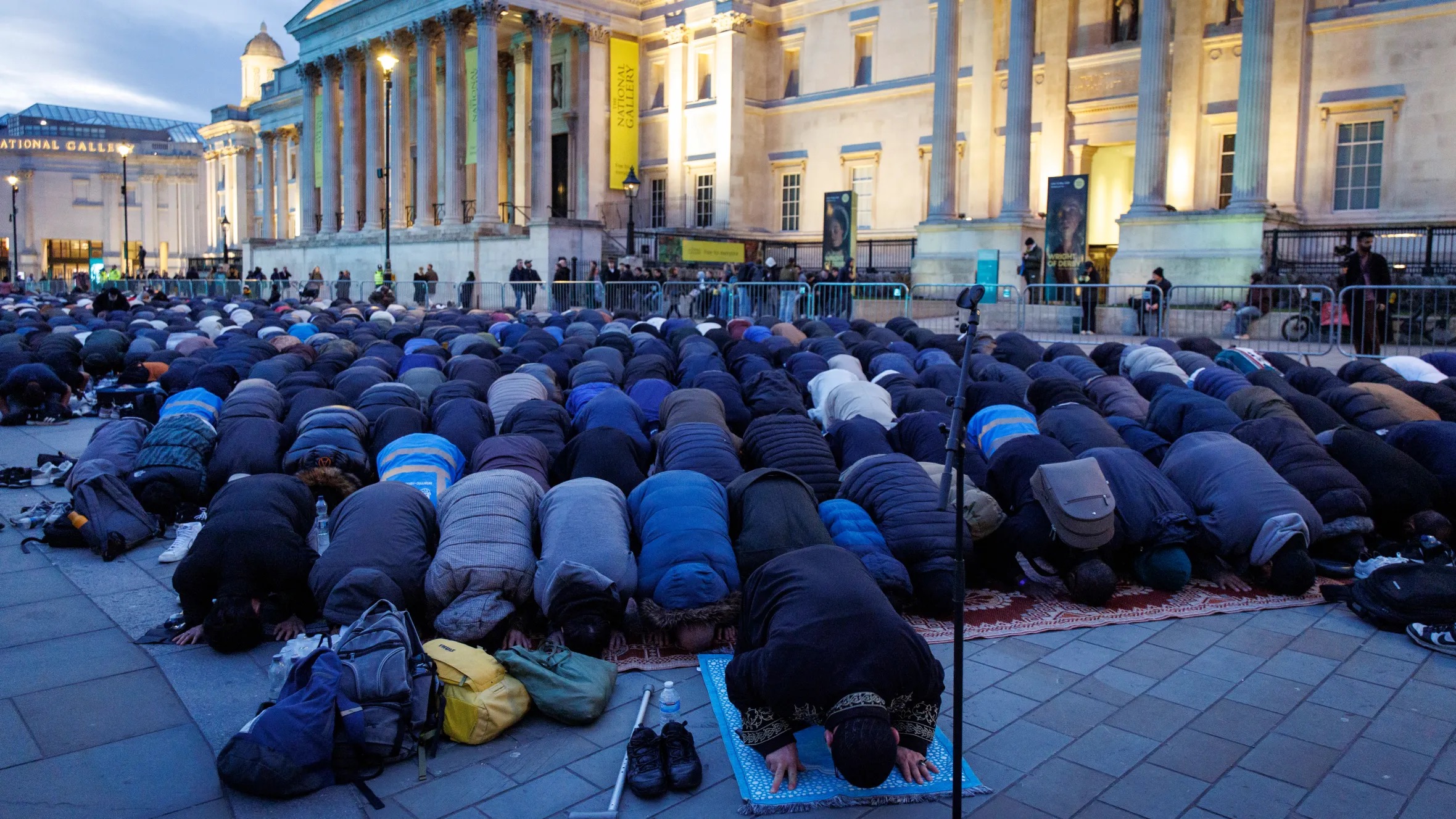
Last month, tourists in Trafalgar Square, London, were greeted with an unusual sight. In the shadow of Nelson’s Column, in front of the National Gallery and St. Martin-in-the Fields church, hundreds of Muslim men knelt down to pray. Led by the city’s Mayor Sadiq Khan, they gathered to mark the end of Ramadan.
While men laid out their prayer mats, a similar event took place over 100 miles to the west, in Bristol Cathedral. There, the dean had invited local Muslims into the nave of the cathedral where they could celebrate the breaking of their Ramadan fast. After the call to prayer went out, the Muslims sat down at tables to eat.
Reaction to these public displays of prayer was mixed. Many saw them as examples of British tolerance and multiculturalism - the fruit of inter-religious dialogue. Others were disturbed by the choice of venues. Were not other spaces, such as public parks, available? The mass prayer meeting in Trafalgar Square, at the center of what was once the British Empire, was described by a Conservative MP as an “act of dominance.”
Such events would have been unthinkable, say, thirty years ago. They reflect the changing face of Britain, where immigration at unprecedented levels has brought rapid changes to the ethnic and religious makeup of the country. So great have been the numbers entering the country, it is estimated that by 2063 those who can claim ancestry going back several generations will be in a minority. This is already true in Britain’s large cities such as London and Birmingham.
In Britain there are many advocates for immigration, which accelerated under both Labour and Conservative governments. Without question immigration has brought many benefits. Yet the desire that all immigrants become woven into the social fabric of the host country remains an aspiration, rather than a reality. Many immigrant groups have, unsurprisingly, kept their cultures and traditions intact. What happens when these foreign cultures come up against the native cultures of the host country?
The question can be applied in particular to Islam, which is the fastest growing religion in Britain. Islam has a different understanding of how society should operate, which reflects its dominance in countries outside of the UK and Europe. Generally speaking, under Islam, the integrity of the group matters more than the integrity of the individual. Britain’s religious identity, on the other hand, was for over 1,500 years formed by Christianity and the Church. The legal and religious freedoms enjoyed by British individuals today are the fruit of this Christian heritage, which developed and expanded during the Enlightenment.
Muslim immigrants to Britain are mainly from countries whose prior exposure to western governance was during the colonial era. While some have adopted western models of governance, such as holding elections, most have kept their indigenous customs unchanged. Pakistani immigrants, for example, while enjoying western freedoms, bring with them cultural behaviors that sit uneasily in Britain’s modern liberal society.
Take, for example, the notion of the biradari. The documentary filmmaker Navid Akhtar identifies the biradari “as the extensive clan network that governs all families and gives values and a sense of identity.” Biradari binds Muslims to the family group, which becomes the focus of unity. At the same time, they act as a straightjacket for those Muslims seeking a more individual, western shaped identity.
Biradaris operate according to a strict code of honor. Youngsters falling foul of the law are often shipped back to Pakistan for “village rehab.” Daughters wishing to marry outside of the clan soon discover that the family has found someone from within the biradari for her to marry. As one family member puts it, “the reputation of the biradari must be protected at all costs. A scandal in one family will tarnish the honor of all.”
While in Britain it was possible, until relatively recently, to claim to be Christian without any strong religious identity, in Islam your identity remains firmly defined by your ethnic and cultural background. You may not visit the mosque, but you are always a Muslim.
Muslims follow the teachings of the Prophet Muhammad, contained in the Qur’an, the holy book of Islam. The teachings have a political as well as a spiritual dimension: enshrined in the Qur’an is the call to make the whole world Muslim. Arguably Christianity has the same call, but the texts of the Christian religion, unlike the Qur’an, do not seek to impose religion by force or coercion. There is no mandate for jihad - holy war - in the gospels. Nor does Christianity mandate death for anyone converting from their religion to another.
The differences between the two religions are reflected in the way their respective nations and countries have developed. Western civilization, based on Judeo-Christian values, has experienced significant social, democratic, economic and artistic change within the past one thousand years. By comparison, Muslim countries that are found primarily in the Middle East, Asia and North Africa, have developed more slowly and have remained socially and religiously conservative.
The identity of Muslim communities remains strongly ethnic. White converts to Islam find it almost impossible to become assimilated into this religious community. Philip Lewis, the interfaith adviser to the bishop of Bradford, was told by a non-South Asian convert: “They are glad you became a Muslim, but would not invite you into their home, and would not consider marrying an 'English' person - or else they see you as an interesting ‘exotic’ showpiece.”
Muslims in Britain often have divided loyalties. In foreign policy, the US and Britain have aggressively waged wars against Muslims in Iraq and Libya. It is not surprising, therefore, that many Muslims are sympathetic to nations who fight against us. A recent terror attack in the US was committed by a US Muslim whose brother had been killed in the bombing of Lebanon.
The current war in Iran, and Britain’s response to it, reveals the influence of Islam on British politics. Britain’s political map has been redrawn by mass immigration concentrated around large towns and cities. The reluctance of Britain’s ruling Labour Party to be drawn into the Iran war reflects a desire to appease their large Muslim voting bloc.
My own experience of living in a town heavily populated by Muslims occurred between 2013 to 2015, when I was the priest in charge of a church in a working class area of Luton, Bedfordshire. Luton has experienced high levels of immigration, historically from the West Indies but more recently from India, Pakistan and Bangladesh. According to the Department of Education, 53% of primary school pupils in Luton do not speak English as their first language. Luton is often mentioned when people talk about the threat from Islamic terrorism. In May 2016 a delivery driver from Luton was sentenced to life imprisonment for plotting to kill US personnel outside an army air base in East Anglia.
Our church was the only place of Christian worship in the immediate area; within a two mile radius there were nine mosques. Living there gave me the opportunity to see first hand how large immigrant populations have adapted to life in a country that was culturally very different to their own. I observed that most people, regardless of their race and religion, were getting on with their lives the same as everyone else. If there were underlying tensions, they weren’t easily detectable.
There were ecumenical initiatives, usually by leaders of the Christian churches, to establish relationships with the local Muslim community. These were cordial and created opportunities for dialogue. I was governor of a local school comprising a mixed board of different religions and backgrounds. Under the guidance of the capable principal, we all worked well together.
That was ten years ago; since then things have changed. In Luton, London and elsewhere, there have been street marches in favor of Hamas. In 2025 the Daily Telegraph reported on marchers at a pro-Palestinian demonstration in London chanting anti-Semitic slogans and calling for the destruction of Israel. Instead of stopping the march, police arrested a Jewish lawyer who was present as a counter-protest. He was handcuffed and detained at the police station for ten hours. His “offense?” The Star of David necklace he wore, measuring less than an inch across, was said to have “antagonized” the marchers.
In Britain, one sees a widespread and growing deference to Muslims in public life. In February and March this year, at the beginning and end of Ramadan, King Charles III gave two separate speeches of support to his Muslim subjects. However the King, who is Supreme Governor of the Church of England, had nothing at all to say to Christians at Easter.
At the King’s coronation in 2023, one of the invitees was Saiqa Ali, a Green Council candidate in Streatham, London. The following year, she posted a picture on her Instagram account of the Earth being crushed by a serpent with the Star of David printed on its skin. Her caption read, “It’s time to cut the head of this snake.” Many of her posts support terrorism and spout anti-Jewish sentiment, yet she enjoys support among the British Establishment and the Muslim community.
There are other reported examples of preferential treatment being given to Muslim extremists. In 2023 the Times of London reported that a leader of Hamas, Muhammad Qassem Sawalha, had been provided with council housing (for people on a low income) in Barnet, North London. He has since bought the house for cash, receiving a £112,000 discount on the purchase price. According to a US Department of Justice indictment in 2004, Sawalha held secret talks about “revitalizing” terrorist acts in Israel and helping to launder money to support activities in Gaza and the West Bank. In 2019, he took part in an official Hamas delegation to Moscow, where he met Vladimir Putin’s deputy foreign minister, and served on Hamas’s politburo between 2013 and 2017.
Advocates for Islam among western liberals believe that Muslims will assimilate once they experience the freedoms and benefits of western society. Liberals even accommodate Islamic practices at odds with Western traditions in order to show empathy and facilitate this integration. The former Archbishop of Canterbury Rowan Williams once suggested that Sharia Law should apply in Britain "if this were thought to be a useful direction in which to move.” Sharia law, however, is fundamentally incompatible with British law, especially as it places women at a disadvantage to men. Sadly, the Archbishop did not take the opportunity to assert the superiority of a legal system grounded in Judeo-Christian values over the more primitive and sexist Sharia law.
His response reflects an ambivalence to our common inheritance, tainted as it is by colonialism and all the other evils of the West. To compensate, liberals like the Archbishop are more ready to defer to Muslims, with displays of what is called “suicidal empathy.” This places the immigrant on an equal or higher moral plane than the native. However, this approach is perceived by Muslims as a sign of weakness. If you do not believe in your own country’s traditions and values, why should we?
When Muslims emigrate to Britain, they are attracted by the benefits of living in a free and relatively prosperous country. Others are refugees fleeing persecution and tyranny. In the process of integration, both host country and immigrants have been changed. How far will this process go? Skeptics point out the inherent incompatibility of secular western and Muslim values. Muslims see the societies of Britain and Europe as godless and immoral, especially with regard to sexual freedom. In geo-political terms, the West is seen as the sponsor of Israel. That almost all terrorist attacks on Westerners are committed by Muslims reflects an ingrained antipathy to the West.
Secular Western societies have been skillful at creating narratives that extol the benefits of multiculturalism, while at the same time seeking to suppress or deny its downsides. Criticism of Islam is labeled “Islamophobic” and a proposition to make such criticism legally punishable is currently being promoted by the Labour Party. A Royal Air Force cadet was recently suspended from a training course for saying that Islam posed the greatest security threat to the UK. It wasn’t that he was wrong - after all, of the 43,000 extremists monitored by MI5, more than 90 per cent are Muslim - it was that he said it at all.
The suppression of critical voices has helped the growth of radical Islam. In January this year the United Arab Emirates (UAE) withdrew funding for scholarships to British Universities, citing concerns about students becoming radicalized by the Muslim Brotherhood. This is all the more disturbing given what the UAE teaches on its home turf. In the UAE itself, British public schools have established private schools where textbooks explain how to deal with “rebellious wives”. There are three stages: “First: good counseling”, “second: refusing bed-sharing”, and “third stage: beating lightly.”
Those who objected to the Iftar in Trafalgar Square and Bristol Cathedral point out that the words of the call to prayer translate as “Allah is the greatest! I testify that there is no God but Allah. I testify that Muhammed is a messenger of Allah. Come to prayer.” The former Queen’s Chaplain, Rev. Gavin Ashenden, explains that this is the Adhan, a call to prayer that “is culturally and historically a proclamation of Islamic faith and proclaims the place has become a place of Muslim prayer: a sign that an area belongs to the realm of Islam.”
Ashenden was deeply upset by the Muslim presence in the cathedral where, fifty years earlier, he had given his life to Christ. He also relates a story of his time as chaplain to the University of Sussex, a role he shared with a Muslim cleric. The two men enjoyed each other’s company and were respectful of each other’s religion. However, when the Muslim cleric was about to retire, he told Ashenden that he was leaving with a sense of satisfaction, having witnessed the growth of Islam in Britain. Moreover, he was convinced that Britain would soon become a Muslim majority country.
If demographic trends are anything to go by, that will become a reality within 150 years. Already the most common name for a baby boy is Muhammad. Will the West survive? While the example of Muslim majority countries abroad does not instill confidence, Britain has a special and unique history. Arguably, no other country in the world has made a greater impact than Great Britain, in terms of its culture, values and principles of governance. It has the potential to provide the rest of the world with an example of what a flourishing and modern multi-cultural society can look like.
However, the early signs are not encouraging. Westerners appear to have lost confidence in themselves and their history. This is partly due to the way that the foundations of Western society have been undermined in recent years. Children today are taught that their country profited from slavery and colonialism. This is usually coupled with the promotion of socialism as a means to redress current “systemic” inequalities.
For most of its history, Britain’s values and principles drew from the Christian faith. Less than a hundred years ago, Winston Churchill could say, without hesitation, that the fight against Nazi Germany was a fight to preserve Western Christendom. Today, no Prime Minister would dare make this claim. In the past thirty years, an over-confident kind of secularism has taken the place of Christianity, with Christians being subjected to mockery and hounded out of British public life. What once sustained and informed the body politic has now been pushed to the margins.
In his recent book The Revolutionary Center, Adrian Wooldridge observes that Muslim fundamentalism “feeds on the West’s perceived decadence…Why respect your host society’s traditions when those traditions are routinely mocked by your hosts themselves?” In promoting an anti-western narrative, the West may be complicit in its own demise. Commentator Dimpee Brar warns that “…If the United States in particular, and the West as a whole, continue to educate their young to despise their own foundations, they should not be surprised when those foundations disappear.”
The speed and scale of the changes to Britain, both cultural and religious, will only accelerate over the coming years. While native Englanders are sometimes wary of displaying their patriotism, for fear of being labeled “racist” or Islamophobic”, a foreign born British citizen has fewer qualms. The leader of His Majesty’s opposition in Parliament, Kemi Badenoch, who was born in Nigeria, recently took part in a radio phone in. In answer to a question from a Muslim caller. Badenoch said: “There's often a conflation between what is cultural and what is religious. We believe very much in the freedom to practice your religion. But when it comes to culture, we need a shared culture.”
That is the challenge facing Britain today.
Father David
Thank you!