
Fjord
Directed by Cristian Mungiu
Mobra Films
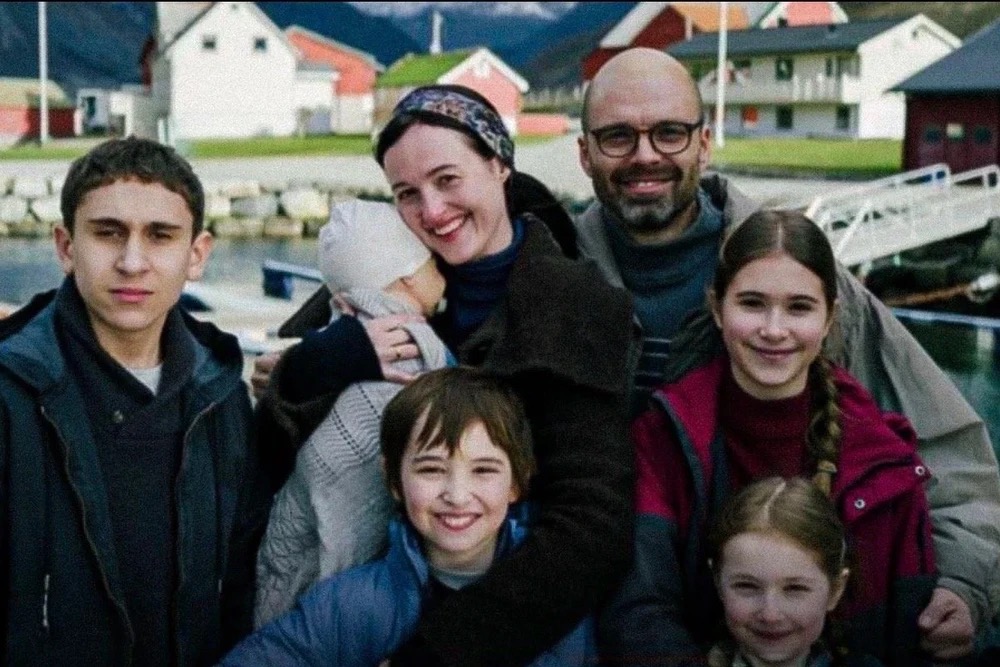
“Nobody could love children more than their parents.” These words are spoken by Mihai Gheorghiu (Sebastian Stan) under cross examination in court, where he and his wife Lisbet (Renate Reinsve) are defending themselves against charges of child abuse. The couple have recently emigrated to Norway, where they have become entangled in an emotionally fraught legal battle for custody of their children.
The movie Fjord, winner of the 2026 Palme D’Or at Cannes, is a study of a clash of cultures. Against a liberal secular state, what rights do parents - and indeed, children - have when the state exercises its authority and separates the family? In this case, the family are traditional Pentecostal Christians who are experiencing hostility on both a personal and institutional level.
Mihai, who is Romanian, works as an IT engineer while Lisbet, who is Norwegian, does part-time jobs and looks after their baby. They have recently moved to a remote Norwegian village to be closer to Lisbet’s family. Every day the family reads the Bible and prays. They belong to a thriving Christian congregation and every Sunday attend church. Discipline at home is strictly enforced. The children have no television or smartphones. If the children do something wrong, they are punished by being confined to their rooms, although sometimes a smack to the bottom is administered.
When they are enrolled in the local school, the children discover how different they are from other children. The two elder Gheorghui children form a relationship with Noora (Henrikke Lund-Olsen), a rebellious teenager of liberal parents. At first Noora charms the Gheorghui children like a devil, offering them things they do not have in order to win their affection, and even threatens to kill herself if they refuse her. In time, Noora develops a serious crush on Elia (Vanessa Ceban), one that is reciprocated. Later in the movie, Noora is one of the few to show compassion to the Gheorghuis.
During a wrestling exercise at school Elia receives a bruise to her neck. A teacher notices it and suspects, wrongly, that Elia is being mistreated at home. This sets in motion a legal and bureaucratic process that will result in the separation of the children from their parents.
Based on a true story, Fjord examines the conflict between two essentially different belief systems. While the separation of children from their parents is required by Child Protection regulations, there is beneath the surface an element of psychological disapproval among those making the decision. Some members of the school, and even the family’s first attorney, do little to hide their dislike of the family and all that it stands for. Although not completely isolated - Lisbet’s neighbor agrees to defend them in court - Gheorghui and Lisbet find themselves unexpectedly engaged in a lonely and heart-wrenching struggle to save their family.
Fjord is a long movie, but I was gripped throughout. The remote Norwegian setting, with its snow-covered buildings and occasional avalanches, provides a stunning backdrop to the action. However, the director Cristian Mungiu has wisely concentrated on the personal drama unfolding before us. The acting throughout is outstanding - at times it was like watching a documentary.
There are a number of incidental stories - perhaps the most touching is the relationship between Åke (Øyvind Venstad Kjeksrud), the father of Mats, one of the Gheorghui’s neighbors, and Lisbet, who has offered to take the wheelchair-bound grandparent out for excursions. Åke never speaks, until one day he tells Lisbet, “I like you. You’re gentle and smart.” The old man is a mostly silent witness to a world he no longer recognizes. Like his granddaughter Noora, he is a rebel at heart. One senses that the wisdom he has to share is of no interest to the generation that has come after him.
Fjord presents both sides of this traumatic story as even-handedly as possible. In court the prosecution, acting on behalf of the Child Protection Agency, makes a persuasive case against the parents. The decision could go either way. It is telling however, that the state has not asked the children themselves whether they want to return home or not.
The struggle between the state and religion is a test of faith for Mihai and Lisbet. In their refusal to submit, they show the power of faith and the resilience of the human spirit. Their example is also a sign of how times have changed. The family and its values would have fitted comfortably into an American 1950s movie, such as say, William Wyler’s Friendly Persuasion. Today, the situation is reversed; it is our society that has become less and less comfortable with families like this.
David Beresford
0 Comments
There are no comments.
Stay Tuned
Sign-up for David's newsletter