
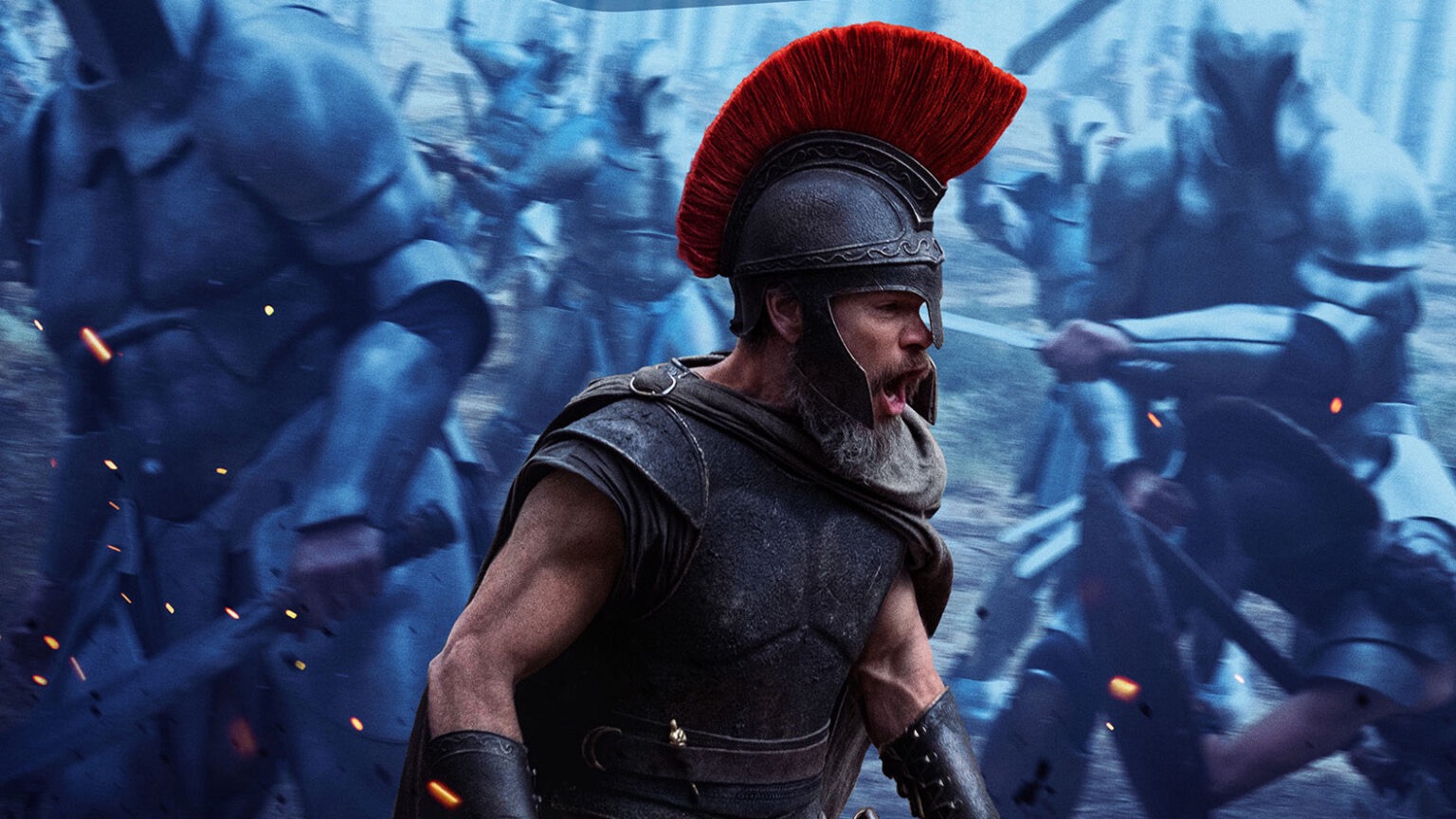
The Odyssey
Director: Christopher Nolan
Universal Pictures
The cinema has always reserved the right to interpret scripture and classic literature in its own way. Do I cast my mother as the Virgin Mary in a movie about Christ? Pasolini did in the acclaimed The Gospel According to Saint Matthew. One of my favorite movies, The Long Goodbye, has Elliott Gould playing private detective Philip Marlowe as a sharp but shambling 1970’s figure, which annoyed fans of the author Raymond Chandler.
Which brings us to The Odyssey, a recent addition to the “swords and sandals” genre, this one based on Homer’s mythological story of the same name. There are significant discrepancies between the movie and Homer’s Greek original, including the removal of some explanatory scenes and dialogue. Director Christopher Nolan would argue that he has artistic license to make these changes, and he would be right. However, some Greeks have been less than pleased at Hollywood’s treatment of their cultural legacy. Writing in the Greek City Times, Le Grec accused Nolan of telling an essential Greek story while rendering indigenous Greeks invisible within it.
Nolan uses Homer’s story to fashion something different for modern audiences. He has shot the movie on 70MM, which is rare (and expensive) these days; it signals his intention to create a movie with an epic scope and narrative. In this field, The Odyssey has some stiff competition: past masterpieces in 70MM include Lean’s Lawrence of Arabia, Kubrick’s 2001 and Kurosawa’s Dersu Uzala.
The Odyssey takes the viewer on a journey that, like most journeys, is a mixture of boredom and exhilaration. Those unfamiliar with the story are likely to be confused during the first thirty minutes, when characters are introduced and the movie jumps around in time. Things improve once Odysseus’s journey begins. Actor Matt Damon is good as the main character; plagued by doubts, he grows ever remorseful for the choices he has made as a military leader.
Odysseus and his men first venture into the cave of the Cyclops. Here the movie becomes exciting and the creature is truly scary. There follow more adventures, based on Homer’s story, where each one has the feel of a dream. Cumulatively, however, they become extended scenes of chaos and loss. It didn’t help that throughout the movie, until his return to Ithaca, I wasn’t relating emotionally to the character of Odysseus. The succession of landings and departures became something of an endurance test. I found myself taking the advice of Calypso, who told Odysseus, “Give yourself to the storm, and take your punishment!”
The role of Calypso, played by Charlize Theron, is written as a modern therapeutic foil to the troubled Odysseus. She is the psychiatrist who falls in love with her patient, and she keeps Odysseus docile by medicating him with lotus flowers. At these and at other times one becomes conscious that these actors are wearing ancient costumes while wading in 2026 cultural waters, rather than attempting to create a new world in which disbelief is suspended.
Odysseus, for all his bravery, is an anti-hero for our times. He regrets the deception of the Trojan Horse. He is disgusted by himself as a warrior and ashamed of the death and destruction wrought upon the city. One is tempted to say to him, “it’s war, dear boy, this is what happens,” but our modern hero regrets all of it. The sack of Troy is a war crime and Odysseus feels responsible.
As the movie condemns the violence and horror of war, it also extols a fighting hero and action man. At the end, the script wants us to take Odysseus’s side, which we do, as he turns into a Greek version of John Wick. The two themes - anti-war and pro-the right to fight - seem contradictory. Which one is the movie advocating? Perhaps the movie is suggesting that violence is justified in personal circumstances.
Technically there is much to admire. An almost continuous soundtrack plays in the background, often low single notes repeated and pounding drums. The overall tone of the movie is dark blue, which reflects the dour and humorless mood. The technical highlight is the editing, which is superbly done.
There are rich visual allusions, such as the falling tower in the siege of Troy, which recalls the collapsing Twin Towers on 9/11. An aerial shot over the burning Troy resembles footage of a city under bombardment. The images of dead bodies on the beach recall those of the Normandy beaches on D-Day.
In my viewing, there was an unexpected technical hitch. After fifty minutes, the reel of 70MM film became unspooled and the screen went dark. Afterwards the film resumed in digital format only. The man next to me struck up a conversation as we waited. At the end of the movie he said, “That was good wasn't it?” I said it felt like five hours had passed. I thought of the late Bonnie Tyler, who sang, “I need a hero.” I did too - just not this one.
David Beresford
0 Comments
There are no comments.
Stay Tuned
Sign-up for David's newsletter