

What is the Point of Life?
“What is the point of life?” As a priest, this question has always underpinned my own faith journey. The question implies a search for meaning and purpose. Having explored other faiths and studied (and abandoned) French existentialism when young, I settled on Christianity. I sometimes think that God wanted me to take a winding walk through the woods of philosophy and religion before arriving at my final destination.
Depending upon who you ask this question, you will get a different answer. Philosophers tend to give circular replies that end up where they began. Theologians point to God. Some say “what’s the point of anything?” and then smile and move on. Artists usually keep it as a question: the art itself is the answer.
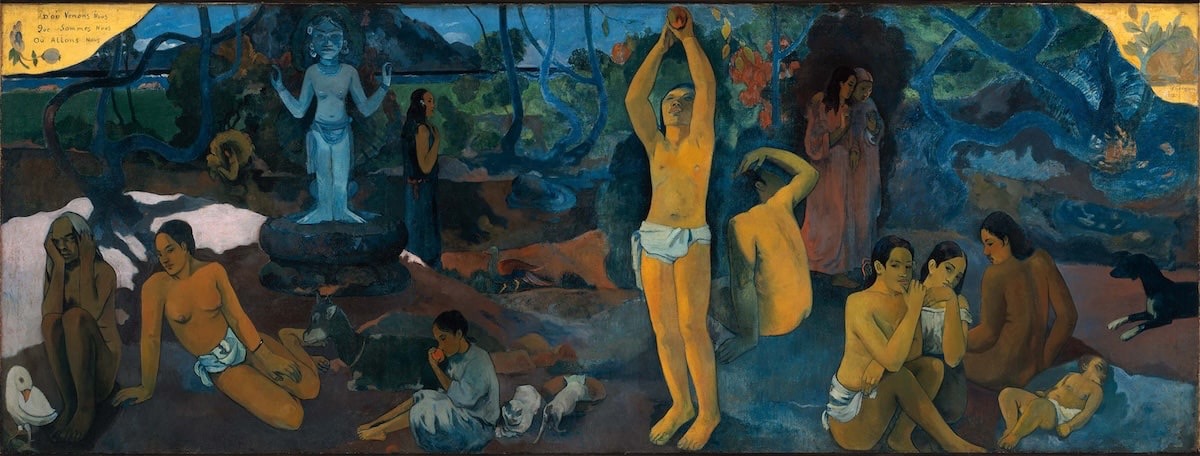
The French artist Paul Gauguin was not thinking about God when he completed his most famous painting in 1898. At the time he was living in the Tahitian islands, beset by money worries and suicidal. When he had finished the painting, he titled it, “Where Do We Come From? What Are We? Where Are We Going?” He came up with the answer by applying himself to the creation of his beautiful and mysterious work; at the end of this process he was able to arrive at the question.
Gauguin later described his painting as a “philosophical work…comparable to the gospels.” (Modesty was not one of his attributes.) It was, he wrote, “a dream: intangible, it implies no allegory; as [the poet] Mallarmé said, 'It is a musical poem and needs no libretto.’” Meaning is conveyed through the tones, colors, and feelings evoked when the painting is viewed.
Gauguin had answered his own question, and that is a clue to how we solve our original question, which is “what is the point of life?” When I put this question to my wife, who is also an Episcopal priest, she replied with a single word: “joy.” And then added, for clarification, “enjoying the gifts that God gives us.”
Joy is a quality that differs from its close cousin “happiness.” Joy is a gift from God that lies deep within our souls; it sustains us in the face of trials and temptations. While we can make our own happiness, we cannot make our own joy - that is, the real, profound joy that comes from knowing that God is real and that we depend on God for everything that matters now and in the hereafter.
Everyone has received gifts from God, to a greater or lesser degree. One gift may be passive, such as the gift of wisdom. Another gift may be active, such as a gift for painting, or a gift for friendship. St. Paul list gifts in 1 Corinthians 12:7-10. There are of gifts of commerce, such as selling and administration; there are gifts of leadership, team-building, and gifts of empathy and supporting others. In my book Call to Love, I wrote that “a willingness to serve God might be the only gift you have.” If that is true, then “offer that and your life will be transformed,” as Father Colin of CSWG suggests. The point of life is to know joy through expressing the gifts we have received from God.
Consider what gifts God has given you. Gifts can be given at different stages in life and for different reasons. Our joy at receiving God's gifts links us directly with him. The mutual receiving and giving of gifts for our joy and God’s joy is a foretaste of the kingdom of heaven. The spirit that holds joy together is the spirit of thankfulness. When you have discovered your gift, give thanks, and you will find joy and meaning in your life.
Father David
0 Comments
There are no comments.
Stay Tuned
Sign-up for David's newsletter