

Magnifica Humanitas
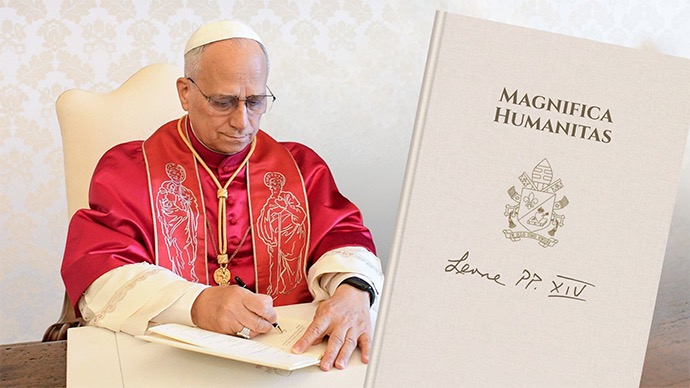
This week Pope Leo XIV published his first papal encyclical Magnifica Humanitas, subtitled “On Safeguarding the Human Person in the Time of Artificial Intelligence.” https://www.vatican.va/content/leo-xiv/en/encyclicals/documents/20260515-magnifica-humanitas.html At 42,000 words long, the Pope’s letter covers a lot of ground; (by comparison, all four gospels total 64,500 Greek words.) Besides addressing issues around Artificial Intelligence (AI), the document outlines a vision for the political and social organization of society.
Prior to reading the Pope’s letter, I reread my own modest reflections on AI which I wrote eighteen months ago. You can read it here. https://davidberesford.net/newsletter/revenge-of-hal-14
In preparing to write about Magnifica Humanitas, I must confess to using AI to define the purpose of encyclicals. l asked Google, and it gave me this AI generated response.
“Popes write encyclicals to apply timeless Gospel teachings to contemporary moral, social, and theological issues. Functioning as teaching letters, they provide authoritative moral clarity, warn against modern errors, and offer guidance for Catholics navigating the challenges of their specific era.”
Previous important encyclicals include Veritatis Splendor (The Splendor of Truth) by Pope John Paul II, who was a bearer of truth for his own generation, and Deus Caritas Est (God is Love) by his successor, Benedict XVI, an admirably lucid and concise - at less than 16,000 words - exploration of love. I find that Leo XIV’s first effort lacks the intellectual rigor of John Paul II or Benedict’s gift of distilling matters to their essence. However, the current Pope is addressing a matter that concerns all of us today: the rapid and pervasive incursion of AI into our lives.
There isn’t space for a detailed examination of so long a document; instead I offer a short critical appraisal, highlighting what stands out, both good and bad.
Pope Leo XIV builds on the Social Doctrine of the Church outlined in the encyclical Rerum Novarum, published in 1891 by Leo XIII. That document focused on the welfare of the working classes and the iniquities of wealth inequality. The current Pope wishes to update that teaching to embrace new technologies, especially AI. One of the looming threats of AI is the probability of job redundancies. The specter of unemployment haunts the economies where AI is adopted.
The term which is repeated throughout Magnifica Humanitas is the “common good.” It is not until chapters 59 and 60 that a definition is provided: the “common good” is “the social expression of the dignity recognized in every person.” In Chapter 12 Pope Leo warns us about “progress that exacerbate inequalities.” Throughout there is an emphasis on the value of human labor and the dangers that threaten it.
“Building a world in which everyone can flourish requires shared responsibility and courage.” This is a world of “subsidiarity”, where everyone works together for the “common good”, and everyone is cared for. Such practices require “responsible planning, the assessment of human and social impact, the inclusion of the most vulnerable, the promotion of digital literacy and guiding research and industry toward justice and peace.” (14).
The encyclical is filled with this kind of language - much of it good and noble - and it is hard to disagree with any of it. However, the devil, as always, is in the detail. Like many a clergyman before him, the Pope appears not to fully understand how businesses operate, and how businesses create wealth by balancing innovation, opportunity and risk.
There is a glaring error early on. In chapter 5 he talks about the changes that technology has brought and states, “In the past, it was largely up to the State to guide and direct innovation.” That is hardly true for most of history’s innovations - they proliferated due to the invention and entrepreneurship of private individuals and later corporations. Innovations such as AI bring opportunities for new growth and create wealth. However, the overriding message from Pope Leo XIV is that AI needs to be developed under supervision and regulation, presumably from government.
The political message is made explicit in “the inseparable link between proclaiming the Gospel and pursuing a more just social order.” The Pope emphasizes that people take precedence over “capital and profit.” (30) He doesn’t acknowledge that a society’s wealth is created by people using capital to create businesses in order to generate profits. Entrepreneurs are not generally motivated by sharing their wealth with others, which in itself is not a bad thing - it’s simply human nature. For all its imperfections, the capitalist system, under which we live, has delivered wealth into more hands than any other.
With regard to our post-industrial society, one of the conclusions that Pope Leo XIV draws is that, “no person or people will be treated as expendable in the processes of development.” (36) This is a noble sentiment, but completely unrealistic from a business point of view. Companies employing workers skilled in an areas that are no longer relevant, due to changing technology, may need to shed staff in order to remain solvent. Of course, new technologies always bring fresh opportunities; companies that innovate and expand will necessarily need workers to fulfill the demands generated by business expansion.
I stumbled upon contradictory statements in chapter 66, which begins by asserting the right to private property, and then later says “the Christian tradition has never recognized the right to private property as absolute or inviolable.” More ambiguity occurs in chapter 68, where “the role of individuals, families, local communities and intermediary organizations should not be supplanted by higher-level authorities.” This is followed by “higher-level institutions must recognize, protect and promote the freedom and creativity of lower-level entities, coordinating their contributions so that they can cooperate effectively for the common good.” Which one is it? Freedom to act independently or for action to be co-ordinated from above?
The tension between recognizing the freedoms of people to act and for the State to intervene is a theme throughout the encyclical. At times it feels as though the Pope wants to have his cake and eat it. He praises and extols the individual and then reminds them to contribute to the common good - if not, then the state will “guide” them. (69)
In chapter 79, Pope Leo mentions “structures, mechanisms and economic and cultural systems that produce inequality.” He doesn’t specify which ones, but it is framed within the context of “social justice.” This is commonly understood to mean inequalities derived from capitalism, for which the answer is a change to socialist systems of government. This where the Pope stops short; by contrast, two of his predecessors make a clear distinction.
From Pope Leo XIII’s 1891 encyclical Rerum Novarum:
“Socialists, by working on the poor man's envy of the rich, are striving to do away with private property, and contend that individual possessions should become the common property of all, to be administered by the State or by municipal bodies…therefore, by endeavoring to transfer the possessions of individuals to the community at large, [socialists] strike at the interests of every wage-earner, since they would deprive him of the liberty of disposing of his wages, and thereby of all hope and possibility of increasing his resources and of bettering his condition in life.”
And Pope Benedict XVI in 2005’s Deus Caritas Est unequivocally states that
“The Church cannot and must not take upon herself the political battle to bring about the most just society possible. She cannot and must not replace the State…she has to play her part through rational argument and she has to reawaken the spiritual energy without which justice, which always demands sacrifice, cannot prevail and prosper.”
Magnifica Humanitas treats social justice in terms of a “fairer distribution of resources or the correction of current injustices, but also assumes a restorative dimension.” (79) Relating this to the new technologies, Pope Leo says that a “just social order” will subject these to “public oversight.” Again, it sounds vaguely reasonable, but how will it be worked out in practice? The danger is that “public oversight” can, in the interests of serving the “common good,” become government interference and control. This is one step toward authoritarian oversight, sanctioned by Catholic doctrine.
In passing, the Pope reminds us of our obligations to migrants (80). This has been a consistent theme of his papacy. In the spirit of Christian charity, the way we welcome and provide for the stranger in our midst is a mark of our faith as Christians. However, there is no attempt to address the rise of Islam which has accompanied mass migration to Europe and the UK, with its associated social problems. How will the “shared vision” of the Pope be fulfilled in a society that is religiously divided? This is both a cultural and religious question that the Pope avoids entirely.
Much of the letter is a wish list for a perfect world but often feels untethered from reality. (81-83) I am always skeptical of those who promote utopias, although I am sure the Pope would deny that that is his purpose. Indeed, he says that “the Church will be able to bear credible witness to society that seeking the common good together, with shared responsibility and fraternity, is not a utopia, but a real possibility.” That’s a fine aspiration, but does it accord with the real world?
In essence, what the Pope desires is for innovation and technological change to be run through the appropriate organizations and bodies before being implemented. In this way, the changes can be evaluated on their contribution to the common good rather than serving as the means for personal and individual gain.
Is it too late though? Where AI is concerned, the genie is out of the bottle. In a competitive world, those who maximize AI will reap the greater benefits. The Pope wants not only to regulate AI but to “disarm” it (110). To do this will require more than the consent of the AI providers; it will require government intervention. Do we really want to hand over control of this important technology to the government?
One of the more interesting issues raised is that of transhumanism - the merging of man with machine. (116) We have all heard by now of the man or woman with the AI partner, especially when the “partner” is programmed to be friendly and affirming. Some damaged people have found solace in such unnatural relationships. What the Pope does not address - but which others have - is the possible demonic influence of AI in the sphere of machine/human relationships. In particular, of evil finding a home in the life of a robot or ChatGPT code. This may sound far-fetched, but it is currently being discussed in theological circles as a genuine danger to human flourishing.
The encyclical attempts to cover all areas relating to AI, including its impact on the family and on the use of military force. In paragraph 192 Pope Leo casually declares that “just war” theory, a doctrine held by the Church for over 1,500 years, is now “outdated” and can be discarded. The reason being is that “humanity possesses far more effective and capable tools for promoting human life and resolving conflicts, such as dialogue, diplomacy and forgiveness.” (192) Again, Leo’s sentiments are laudable, but one wonders if his views would be different if he were living in a country under constant threat of attack from its neighbors.
One of the problems in reading the Pope’s mind is the vagueness of the letter - something that would have been impossible under say, Benedict XVI, who always wrote with precision. For example, what is the “diversity” referred to in paragraph 206? We can guess, but another may guess differently. Why hint at something instead of speaking plainly?
It must be noted here that it is unlikely, given the length of the encyclical, that Pope Leo XIV wrote it entirely himself. This may account for the sometimes uneven and vague presentation of its themes. Oddly enough, its style resembles a document written by AI. That makes it a slog to get through and will limit its popular appeal. One can’t help but think that what it says could have been said with fewer words. To save time, one commentator online suggested asking AI for a summary.
Magnifica Humanitas doesn’t cover everything. Absent from the Pope’s letter is an appreciation of the benefits of AI: for example, how it will improve the search for better medicines, or how it enables smaller business owners with fewer employees to compete with larger corporations. AI is already being used effectively in the current political campaign for Los Angeles mayor. AI has a sense of humor too - go to YouTube and watch Elon Musk's City On Mars from the Babylon Bee.
Although I have critically focused on particular aspects of the letter, there is much to appreciate. It encourages Christians in their roles as peacemakers. It reminds us that “What saves humanity is the divine love that descends into the most fragile point of our history and renews it from within.” (232) The last chapters, starting with 235, provide an exhilarating affirmation of humanity’s purpose in relation to God and each other.
One hears the influence of the Holy Spirit in these final chapters, which soar above the rest of the encyclical. Take, for example, these words: “I invite everyone to cherish places and times where physical presence remains crucial, such as shared meals, Christian community gatherings, time spent with the lonely and serving the poor. These are signs of a humanity that continues to believe that every person’s body is a dwelling place of God and a temple of the Holy Spirit.” (239) It is in such practices that the life of God becomes reality.
Above all, Magnifica Humanitas asks us to remember our humanity: to protect it, cherish it and safeguard it against the forces that seek to dehumanize or degrade it. Pope Leo XIV has given serious thought to the challenges of AI and draws attention to the many dangers it presents to humanity. His encyclical does us the service of making us reconsider what it means to be human, made in the image of God, and created for a purpose that accepts no substitutes.
Father David
0 Comments
There are no comments.
Stay Tuned
Sign-up for David's newsletter