

Confessions of a Film Junkie
It was nearly fifty years ago that I sat in a cinema, pen and paper in hand, ready to begin my new assignment. As the lights dimmed and the curtains drew back, the first flickering images appeared on screen. Soon I began scribbling furiously, recording snatches of dialogue, names of characters and places, scenes and first impressions. My spider scrawls covered the page from one side to the other, never in a straight line, some lines overlapping in the darkness.
I was taking notes for my first movie review for the university magazine. The movie, if I recall rightly, was Audrey Rose, starring Anthony Hopkins. I don’t remember much about it, and my review has now passed into the shadows of history.
I was then, as now, a student of film - not “movies,” which was the American term. Home was Wellington, New Zealand, about as far away from the rest of the world as it was possible to get. I was a passionate film autodidact. The cinema was my window into a world I had yet to experience.
At the time I was studying drama at Victoria University. One term included film as a subject to be studied. I remember our lecturer borrowing 16mm prints from the National Film Archive to be screened in a room downstairs in a separate building that housed the drama department. This is where I saw Carl Theodore Dreyer’s Day of Wrath for the first time. In my experience films were genuine works of art, able to convey not only emotions, but concepts and ideas.
I studied the history and technique of film. The silent cinema had Chaplin and Keaton, but also Dreyer, Lang and Eisenstein. I learned about montage - the principle of “one plus one equals three.” I learned how the brilliant light of California was perfect for the “insensitive” film stock of early cinema. Then I discovered how German expressionists used shadow as well as light. I learned about lenses, depth of field, the studio system and the influence of European artists who came to America in the 1930s. I discovered that films could express an individual’s artistic intention as much as poetry or art. Students of film tend to adhere to the auteur theory of filmmaking, where the director is responsible for the success of the film and for its message.
Fifty years ago there were only two places you could see a movie - the cinema and television. There were no videos, DVDs or Blu-Rays. I joined the Wellington Film Society, which offered a steady diet of foreign films, both old and new, from Europe, the Middle East, Africa and Asia. I have a strong memory of seeing Godard’s A Bout de Souffle for the first time. My friend Simon Wilson and I had never seen a movie like that before. It was exciting and, of course, we both identified with the main character, who was a chain smoker (we both lit up cigarettes as soon as we exited the cinema.)
As well as reviewing mainstream releases, I got to review movies that were being screened at the annual Film Festival. In those days, there might be three of four screenings each day of different movies. The films would arrive by plane from overseas and the film canisters would be driven from the airport to the cinema. The film would be screened and the reels then sent onto another Film Festival or flown back to their place or origin. Thus you had only one opportunity to watch the movie. During the film festival I would jot down notes onto the writing pad and then go home and write the review, sometimes not finishing until the early morning. I remember going to the doctor asking for something to keep me awake. The strongest thing he was willing to prescribe was caffeine citrate, which worked well enough. Later in the day I would repeat the same procedure.
I loved European movies because they had a style and pacing that was often slower than American movies. Style often reflects culture. France, Germany and Italy all produced great movies. One of the most prolific and famous filmmakers was a Swede, Ingmar Bergman. He made films about God and human relationships that were gloomy and complicated. I loved them because Bergman was a great artist. I remember seeing his extraordinary and powerful movie The Virgin Spring on afternoon TV. I still marvel that it was broadcast then - a more cultured time.
Often the movies I saw were minutes shorter than their actual run time. In common with most countries, films had to be submitted to a film censor before being passed for general distribution. The monthly Film Society newsletter contained a list of all films submitted that month, along with their classification and whether they were banned, passed with cuts or passed uncut. In New Zealand, almost every movie that wasn’t banned was passed with cuts. The censor even cut the Muppet Movie (for violence), much to our national embarrassment.
I once met the film censor when he came to talk to a gathering of people from Rotoract. Where movies were concerned, he had clear notions about what was acceptable and what wasn't. No f-words in any movie, no use of a switchblade and, if there was a fight scene, only “one on one” combat. As for sex, that was a no-no, although the 1975 New Zealand movie Test Pictures kept its sex scene uncut. (I think the censor made an exception in order to support the local filmmakers.) During his talk, someone cheekily asked the censor why, if he spent so much time indoors, his face was so red? The censor replied that seeing some of the things he saw, he needed a stiff drink now and then to restore his equilibrium.
My short career as a film reviewer came to an end when I left university. I never lost my love for the cinema, however, and continued to watch for new films from auteurs I still followed. Some, like Werner Herzog, whose Heart of Glass I saw and reviewed years ago, are still working today.
Then last year I attended a conference at St. Louis where I met the editor-in-chief of the Living Church Magazine. The magazine had kindly published a review of my first book Above & Below. During one of the coffee breaks I got talking to the editor and then out of the blue he asked me if I would like to do a movie review. I said “yes,” and ever since I have been reviewing movies for TLC magazine.
This is how I found myself in the Bryn Mawr Film Institute last week, pen and paper in hand, wondering at the way history was coming full circle. As I waited for the movie to begin, I felt that same sense of excitement and anticipation I had nearly fifty years ago. Movies have always been more than entertainment for me. As a Christian, some of the finest artistic expressions of the Christian faith are found in the cinema.
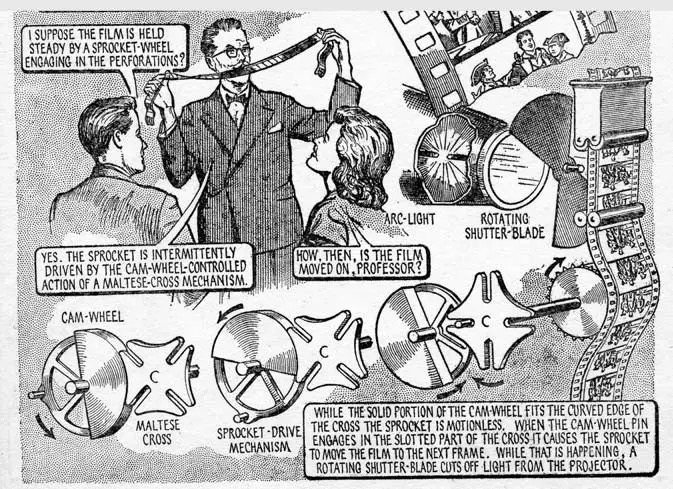
What was the movie? It was Christopher Nolan’s The Odyssey. When it began, I heard the whirring noise of the old 70MM projector behind me. It was a strangely romantic sound, like an old steam train running down the tracks. Everything went fine until the fifty minute mark. As the Cyclops let out a howl of pain, the reel of film jumped off the projector. We briefly saw the image of sprocket holes on the screen before everything went dark. At first I thought it was deliberate - a Monty Python hommage.
Soon the lights came up. A man from the Institute came and apologized for the interruption. There would be a short break while they tried to fix the problem. The man in the seat beside me asked “who was this famous person he was sitting next to?” I told him I wasn’t famous but doing a review. I said that, in my experience, this was going to be a long intermission. In fact, it provided the mostly elderly audience with an unexpected and welcome bathroom break.
When the man from the Institute returned it was to tell us that the remainder of the movie would be projected in the digital format. To be honest, there wasn’t much difference in quality between the 70MM and the digital projection. Perhaps in 70MM Penelope’s freckles were more visible. For our trouble, each member of the audience received a free ticket for our next visit.
At the end of the movie there was a smattering of applause. My mind was already working on the review. Sometimes the first impressions are the best. After a few days the review was finished and will be published next week in The Living Church magazine. It will also appear around the same time on the Blog section of my website. Check it out and let me know what you think.
Dear reader, I have been writing a regular, weekly meditation for some time, and now I have decided to take a sabbatical in August. Thank you if you have shared feedback with me. I do my best to reply to every email. I hope to resume writing these meditations in September 2026. In the meantime, God bless you and have a great summer!
Father David
0 Comments
There are no comments.
Stay Tuned
Sign-up for David's newsletter