

Change and Changes
Some years ago I came across some unusual graffiti in a restaurant bathroom. Written neatly on the wall in black felt-tip was the message: “Changes are temporary. Change is permanent.” I wondered if the author had recently come from a philosophy class and couldn’t wait to impart his newly found knowledge. Or perhaps an old hippie had written it? It had that kind of 1960s “far out, man” vibe. Whatever its origin, it got me thinking.
Change is permanent. That’s talking about change as a concept, or a state of being. We are constantly in a state of change. I see you now and then I see you a year later and you have changed. The earth’s weather patterns are in a state of constant change. No two days are alike.
Then there are changes, like moving house, or leaving college. Changes are temporary, but we all have to face them. Some changes we plan ourselves and some happen against our will. Some people cope with changes better than others. A resistance to change can cause anguish, which is why it is better to accept and welcome change as an opportunity for personal growth.
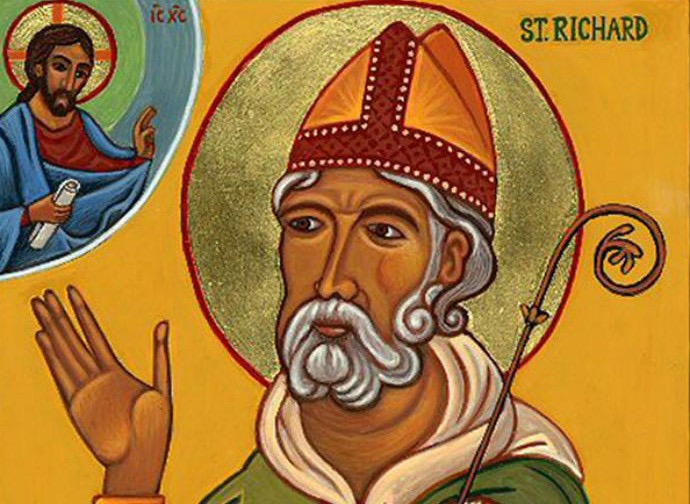
Yesterday was the feast day of St. Richard of Chichester, who died in 1253. The cathedral dedicated to the saint is one that has a special meaning for me, for it was there in 2009 that I was ordained. St. Richard’s life is a good example of how to navigate the various changes in life without losing your identity or sense of purpose.
Richard was the son of wealthy parents. He showed a keen interest in books when young, and set his mind on becoming a scholar. Unfortunately, when both parents died, the estate passed into the care of guardians, who squandered what wealth there was and brought the family to the brink of bankruptcy. When Richard’s elder brother finally inherited the estate, Richard set aside his plans to study at Oxford and went to work for his brother as a laborer on the farm.
Eventually the farm recovered financially, due in no small part to Richard’s hard work. Richard’s brother offered to make the farm over to Richard, but the offer was declined. In all those years working the soil Richard had never let go of the dream he had of becoming a scholar. He left the farm and went up to Oxford.
As a student Richard lived in poverty. His food and accommodation were basic, and on cold winter days he had to lay his books aside and run about in order to keep warm. Come the summer, he spent many weeks on vacation, helping to bring in the harvest. This is the origin of our long summer vacations.
Richard trained for the priesthood and became a parish priest in Kent. However, the new Archbishop of Canterbury wanted him as the new bishop of Chichester, and Richard reluctantly agreed. However, his predecessor had been a favorite of King Henry III, and Richard found himself in the middle of a political struggle. Displeased with the appointment, the King took for himself the properties and revenues that rightfully belonged to the bishop’s office.
Richard thus began his ministry as bishop without house or income. However, he found food and lodgings in the home of Simon, a poor parish priest who lived in Tarring. Richard had many deprivations, but never let them become the focus of his life. He said:
“Do you not understand what is written in the Acts of the Apostles; how they rejoiced that they were counted worthy to suffer shame for Christ’s name? I tell you that God of His grace will turn our tribulation to joy”.
In the exercise of his ministry, Richard journeyed on foot throughout the Sussex countryside, visiting villages across the South Downs. His fortunes changed when King Henry III unexpectedly restored the bishop’s property and revenue. It turns out that the Pope had threatened the King with excommunication if he didn’t comply. Richard continued to shepherd his flock in the Diocese of Chichester until his death in 1253.
There is something admirable in the way St. Richard of Chichester moved through the many changes of his life with resignation and grace. No doubt he was fortified by his faith, which ran through his life like grain runs through wood. He understood how faith changes and grows the older we get. He is perhaps most well known for this famous prayer:
Thanks be to you, my Lord Jesus Christ,
for all the benefits and blessings which you have given to me,
for all the pains and insults which you have borne for me.
O most merciful Redeemer, Friend and Brother,
may I know you more clearly,
love you more dearly,
and follow you more nearly. Amen.
The yearning to love God more dearly never grows old. When the light of love burns within us, it brings changes that strengthen us in the here and now and prepare us for the life to come. The changes of Richard’s life, both good and bad, were gifts from God, to be accepted with gratitude. This is a sign of the true saint, as one who gives the best of themselves in any situation.
Father David
0 Comments
There are no comments.
Stay Tuned
Sign-up for David's newsletter