

A Tale of Two Brothers
In October 1994 I saw the Kinks on stage at the Congress Theatre, Eastbourne. The band were part of the “British Invasion” of the USA back in the 1960’s, and could have been as popular as the Beatles or the Rolling Stones, had not a travel ban kept them away from the US between 1965-69. Their leader, Ray Davies, penned some of the greatest pop songs of all time, often with a decidedly English flavor (Ray has been called the Charles Dickens of rock music.)
At Eastbourne the band opened with their 1965 single “Till the End of the Day.” Guitarist Dave Davies strummed each chord and drove the song through its changes, with the band creating an exhilarating wall of sound that sprung out from the speakers and grabbed the audience, metaphorically speaking, by the throat.
That was my abiding memory of the concert, along with Ray, between songs, eulogizing English traditions and the importance of honoring them. However, there was one other incident which I remember. At one point Ray and Dave started to snipe at each other. Eventually a member of the audience got tired of it and shouted out sarcastically to Ray, “why don’t you have an argument with Dave?” To which Ray shot back, ”Why don’t you get a life?”
Ray and Dave are brothers with, as is often the case, different temperaments and character. During the course of the band’s lifetime, these differences frequently led to arguments and disagreements, much to the exasperation of the other band members. (Original bassist Pete Quaife left the band in 1969, partly to escape the tensions.)
It’s an old story. The Bible is filled from beginning to end with stories of brothers who didn’t exactly see eye to eye. The first is from the book of Genesis, with the story of the brothers Cain and Abel. Both brought an offering before God, but only Abel’s offering was pleasing to God. The jealous Cain murdered Abel, and lied when questioned by God about Abel’s whereabouts.
Later in the book of Genesis we hear about the brothers Esau and Jacob, the children of Isaac and Rebekah. The brothers are twins, but very different from one another. Esau, the firstborn, who inherited his father’s birthright, “came out red, all his body like a hairy mantle.” His brother Jacob, whose physical aspects are not described, was born gripping Esau’s heel. The name “Jacob” is a play on words: the original meaning for Ya´aqob – “May God Protect” – is punned with aqeb, “heel."
Esau and Jacob were, in temperament, as different as chalk and cheese. Esau loved to hunt both game and foreign wives. The first pleased his father but not the second. Jacob, on the other hand, preferred staying at home with his mother Rebekah. Esau, the skillful hunter, was his father’s favorite. Jacob, the quiet homebody, was his mother’s. The author of the story thus sets up a tension between the two brothers from the beginning.
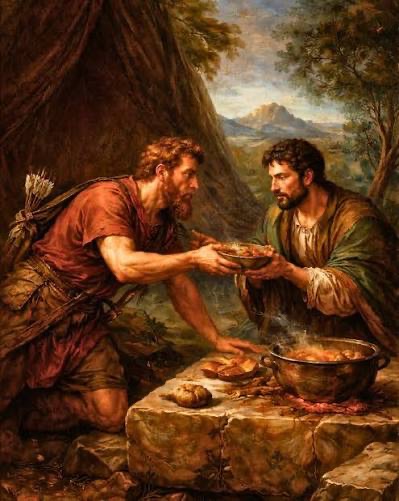
One day, when Esau returns home after a hunting expedition, he smells the delicious stew that Jacob has prepared. “Let me eat some of that red stuff, for I am famished!” Esau says (Genesis 25:29). Instead of pouring his brother a bowl, Jacob negotiates the stew for Esau’s birthright. Famished from his outdoor exertions, and eager to eat, Esau swears away his inheritance.
This story always reminds me of the time I heard the then presiding bishop Jefferts-Schori at St. Alban’s cathedral in England, discussing this particular passage and accusing Jacob of, in her view, “defrauding” Esau. In a court of law, Jacob would probably have been found guilty. But was his action justifiable in any sense?
I remember another sermon by my parish priest, Father Freddie, in which he talked about God having “favorites.” I had never heard of this before. Surely God treats us all equally? True, but in the story of salvation, God has chosen certain people to embody and carry forward his divine plan. Jacob was one of them.
In acquiring the birthright, which involved a further deception of his father Isaac, Jacob has arguably committed a wrongdoing. On the other hand, how worthy was Esau to possess it in the first place, if he was willing to trade it for a pot of stew? The inarticulate, virile Esau may have been strong and skillful as a hunter, but he did not possess the qualities of a true leader. In making his impulsive, careless decision, he proved himself unworthy to carry the mantle of authority.
What was it then, that God saw in Jacob? On the surface, it seems unlikely that God would prefer the feminized Jacob over the more masculine Esau. But the calculating Jacob united in one person the intelligence and resourcefulness that the nation of Israel would need in order to survive.
The story of Jacob and Esau tells us something about how God’s plans are subject to change and can take an unexpected turn. Because God is not a puppet master, the direction of God’s plan depends to a certain extent on ourselves. The lesson to take from this story is that we must honor the blessings we have received from God. That was Esau’s mistake: he didn’t take his birthright seriously, which made him vulnerable to having it taken from him.
His brother Jacob, ambitious for himself, took the birthright from his brother with, it must be added, a little help from his mother Rebekah. Yes, it was wrong for him to do so, but brothers are rivals, and it’s the kind of thing any brother might do, given the chance. Jacob took God seriously, knowing the importance of what he had acquired. By faith he overcame his many trials with cunning, determination and resourcefulness. Above all, in times of need, Jacob always turned to God for help.
Sibling rivalry continued to feature in Jacob’s story through his son Joseph and his brothers. It is also interesting to observe that the first disciples whom Jesus called, Simon and Andrew, were brothers, as were the next two, James and John. As for Ray and Dave Davies, they stuck it out another year or so before breaking up the band. In spite of their differences, they had held the Kinks together for over thirty years, both believing in the value of belonging to the one thing that was greater than them.
Father David
0 Comments
There are no comments.
Stay Tuned
Sign-up for David's newsletter